Introduction to Maximal Extractable Value (MEV)
Maximal Extractable Value (MEV) is a concept that has garnered significant attention in the cryptocurrency ecosystem, particularly in the context of Ethereum. MEV refers to the maximum value that can be extracted from block production beyond standard block rewards and gas fees. It involves manipulating transaction order and execution on the blockchain to gain additional value, impacting both transaction participants and miners.
Issues caused by MEV
MEV can lead to several issues:
- Unfair treatment of transaction participants: Miners have the power to choose which transactions to include in a block, potentially favoring some transactions over others, resulting in losses for certain participants.
- Market instability: MEV operations can influence transaction execution, causing abnormal price fluctuations in the market.
- Network efficiency problems: MEV can lead to transaction congestion, increased fees, and reduced network performance as participants compete for block inclusion.
Types of MEV
Maximal Extractable Value (MEV) primarily falls into two categories:
- Transaction Order Manipulation: Miners benefit by altering transaction sequences, inserting their own transactions before or after others to gain advantages.
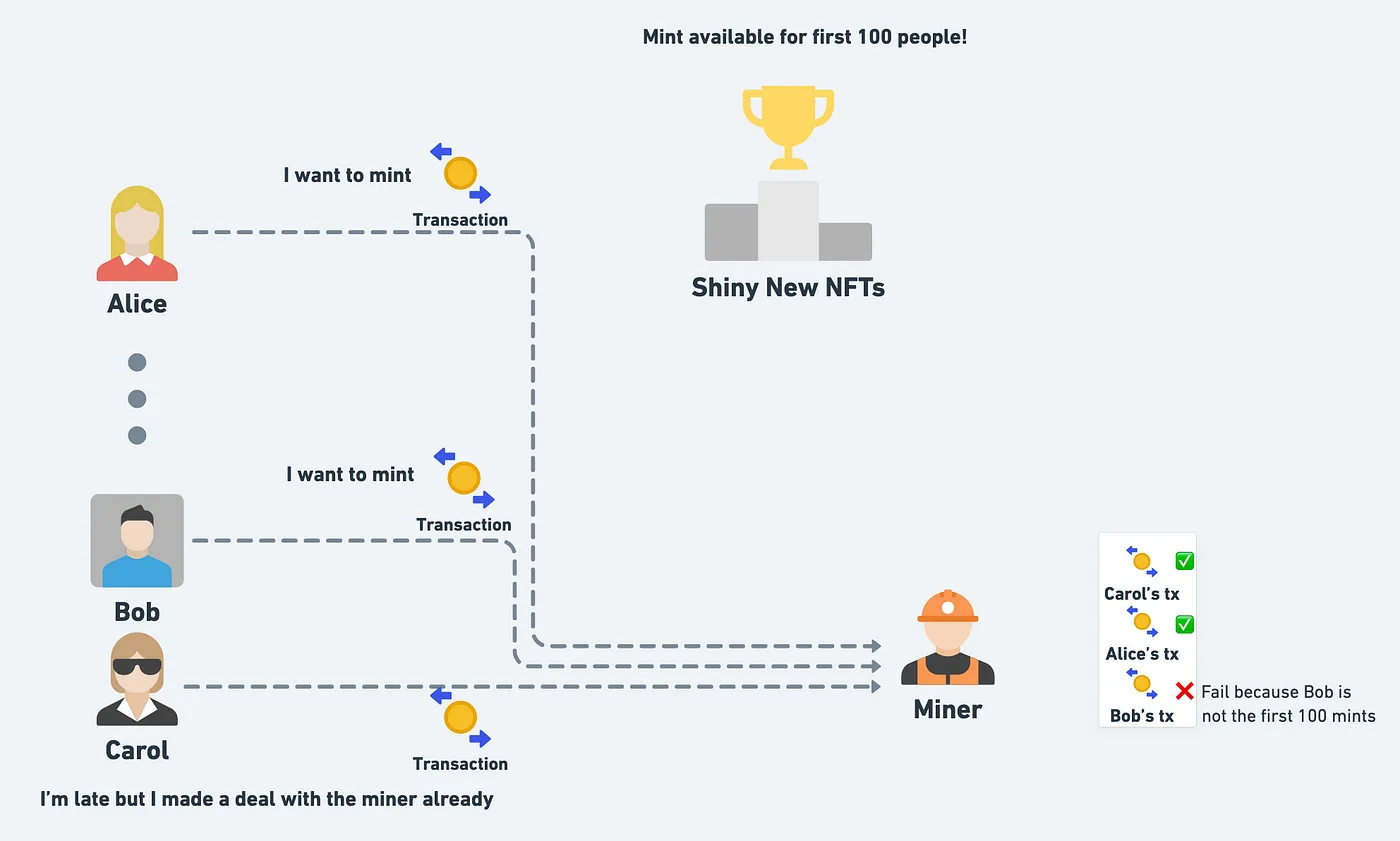 For instance, in a scenario where only the fastest 100 transactions can successfully mint an NFT, a user like Carol, who has a special arrangement with a miner, can ensure that her mint transaction is placed before others through transaction sequencing manipulation.
 - AMM Trade Front-Running: Miners exploit Automated Market Maker (AMM) trades to force users to execute transactions at unfavorable prices. The profit extracted by miners is the difference between the user’s expected price and the worst price at which the trade is executed.
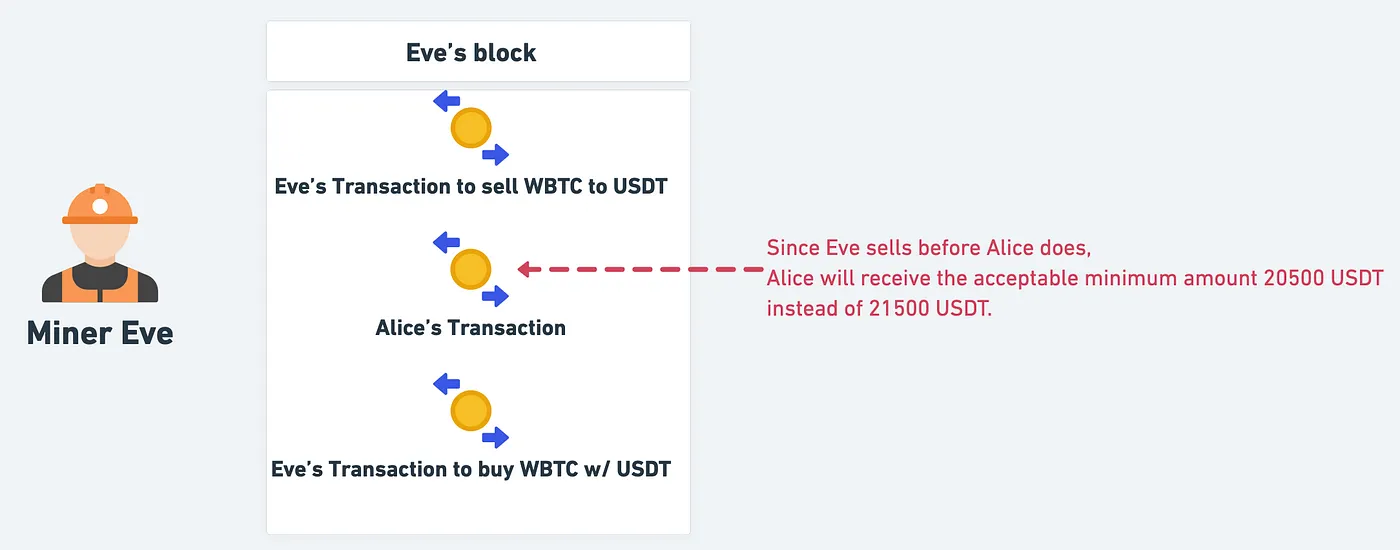
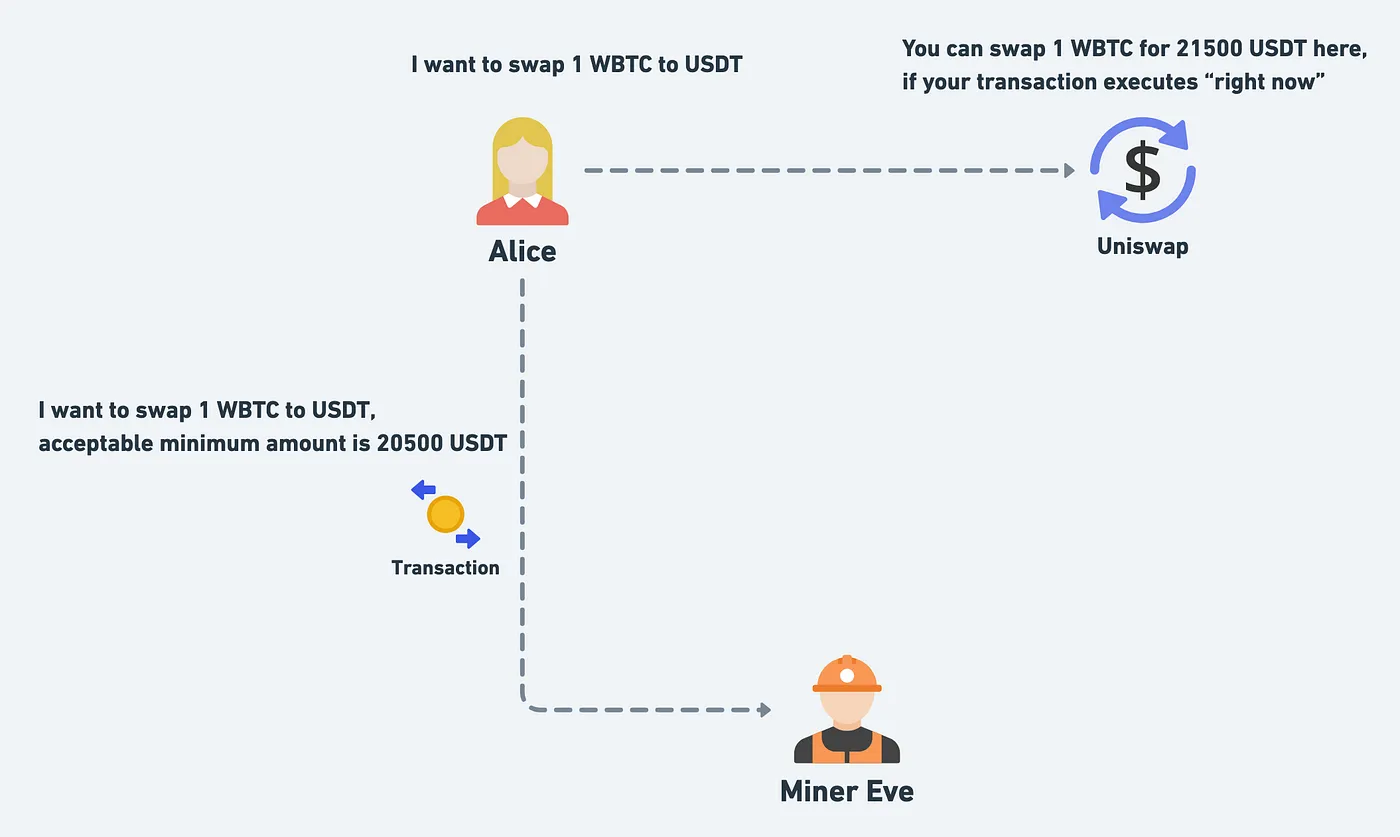 For example, if Alice expects to exchange 1 $WBTC for 21,500 $USDT but the AMM price fluctuates, she may set a worst acceptable price of 20,500 $USDT. A miner like Eve can preemptively insert a trade to sell $WBTC before Alice’s transaction, causing the price to drop to 20,500 $USDT, forcing Alice to trade at that lower price. Subsequently, Eve can buy back $WBTC at a price lower than 20,500 $USDT, completing a profitable arbitrage by buying low and selling high.
MEV Solutions
To address the issues caused by Maximal Extractable Value (MEV), the community and developers have proposed various solutions. One significant solution is based on the concept of bundle auctions, exemplified by Flashbots. By introducing roles like Searcher and Relay in a public bidding environment, this approach aims to make MEV competition more transparent and efficient Basic Process of this Mechanism:
- Allow Searchers to Identify MEV Opportunities
- Compete through Bundle Formation
- Relay the Bundles to Block Producers
Flashbot in POW and POS Consensus Mechanisms
Flashbot in the POW Era
Flashbot transforms MEV into a public market where miners collaborate with professional MEV Searchers to share MEV profits. This collaboration involves intense competition between miners and MEV Searchers. While this setup allows each party to focus on their expertise without interference, it still presents centralization drawbacks as all MEV Searcher arbitrage trades must pass through a centralized Flashbot server, which could potentially manipulate opportunities or scrutinize trades. In the POW consensus mechanism, MEV Searchers must trust that miners will not seize their bundle contents. If such an incident occurs, Searchers can only counteract through off-chain mechanisms like providing evidence to have the miner blacklisted by Flashbot or raising awareness on platforms like Twitter. Generally, miners adhere to the rules as disrupting the relationship with MEV Searchers for short-term gains could lead to a loss of future opportunities, making it unfavorable for them. Efforts are ongoing to enhance MEV solutions and protect users from unfair practices within the cryptocurrency ecosystem. These initiatives aim to strike a balance between efficiency, transparency, and fairness in transaction processing.
Flashbot in the POS Era
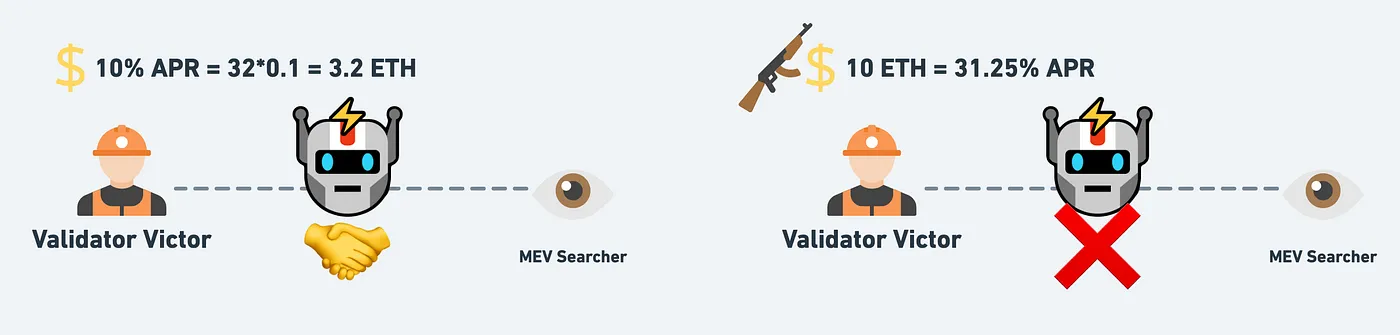
Transitioning to a Proof of Stake (POS) consensus mechanism allows individuals to participate as validators by staking ETH to earn block production opportunities. This shift has lowered the threshold for block production, attracting more participants and diluting the chances of block production. Unlike in Proof of Work (POW), where miners invest significantly to operate long-standing mining pools, validators in POS only occasionally secure block production opportunities. Despite this, with the average annual return from block rewards and MEV calculated at 10%, validators still have a strong incentive to compete for MEV opportunities with MEV Searchers.
In a collaborative scenario between validators and MEV Searchers, each validator earning 10% APR would yield 3.2 ETH in profit. However, by seizing a 10 ETH arbitrage opportunity, the APR could reach 31.25%. This implies that as long as a validator captures more than 3.2 ETH of MEV, their APR can exceed 10%.
The evolution of MEV solutions reflects ongoing efforts within the cryptocurrency space to address challenges and enhance fairness and efficiency in transaction processing. These developments aim to strike a balance between incentivizing participation and safeguarding against exploitative practices.
mev-boost
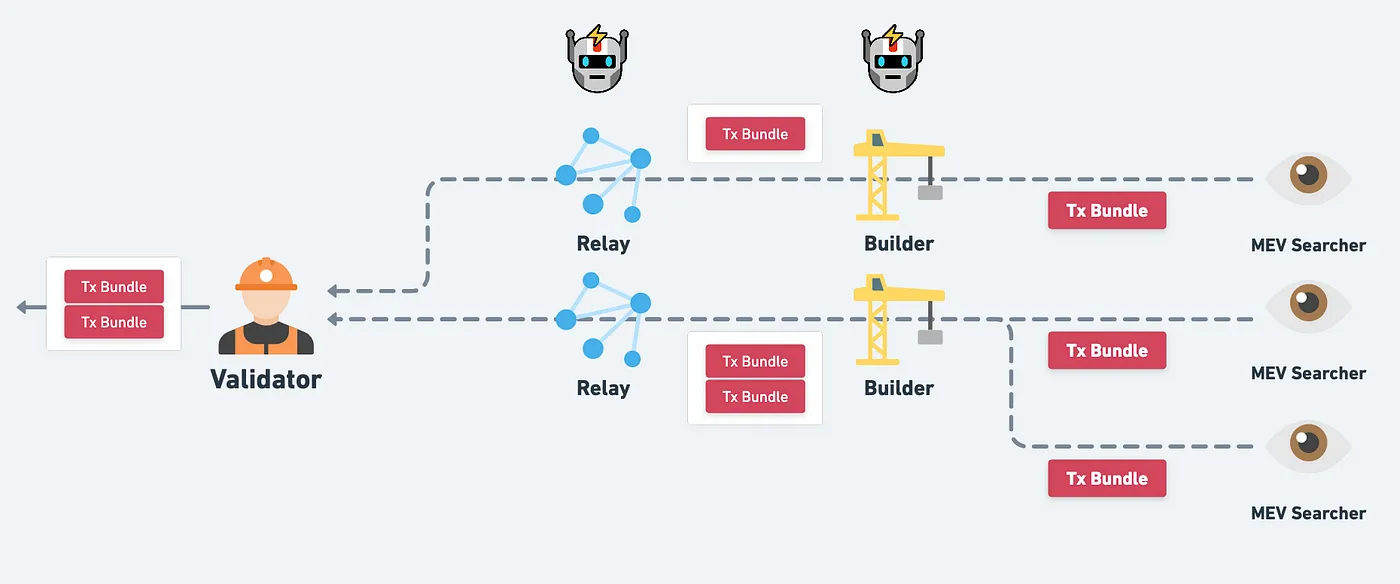
To address the challenges in the Proof of Stake (POS) mechanism, Flashbot’s architecture requires adjustments to align with new trust relationships and the POS mechanism, giving rise to mev-boost. mev-boost divides the intermediary role between MEV Searchers and miners in Flashbot into two roles: Builder and Relay. The basic process involves:
- MEV Searcher hands the bundle to the Builder.
- The Builder selects several bundles from multiple bundles to form a block and passes it to the Relay.
- Validators then choose one block from multiple blocks submitted by Relays.
Roles Relationship:
- Builder: Responsible for selecting the most advantageous bundle combination within a block’s limited space, aiming for Validator selection.
- Relay: In the POS consensus mechanism, where MEV Searchers and Builders cannot trust Validators, Validators in mev-boost must first commit to “I will propose your block” to receive the actual block content. The Relay acts as an intermediary between the Builder and Validator, coordinating this process by safeguarding block content until receiving the Validator’s commitment before passing the block created by the Builder to the Validator.
Tripartite Relationship:
- MEV Searchers compete with each other.
- Builders compete with each other.
- Validators select the most advantageous block.
The evolution of solutions like mev-boost reflects ongoing efforts within the cryptocurrency space to enhance fairness, efficiency, and transparency in transaction processing. These developments aim to strike a balance between incentivizing participation and safeguarding against exploitative practices.